A common mistake we see with road projects around Hobart is assuming the local dolerite-derived clays behave the same as sandy subgrades from other regions. Without a proper CBR study for road design, the pavement thickness ends up guessed rather than calculated. That leads to either premature cracking or overspending on unnecessary base layers. In Hobart, the subgrade conditions can shift dramatically between the coastal alluvial flats and the weathered dolerite slopes further inland. A targeted CBR study for road design catches those variations before the paver arrives. We run the tests with controlled moisture conditions and compaction levels that match what the contractor actually achieves on site.
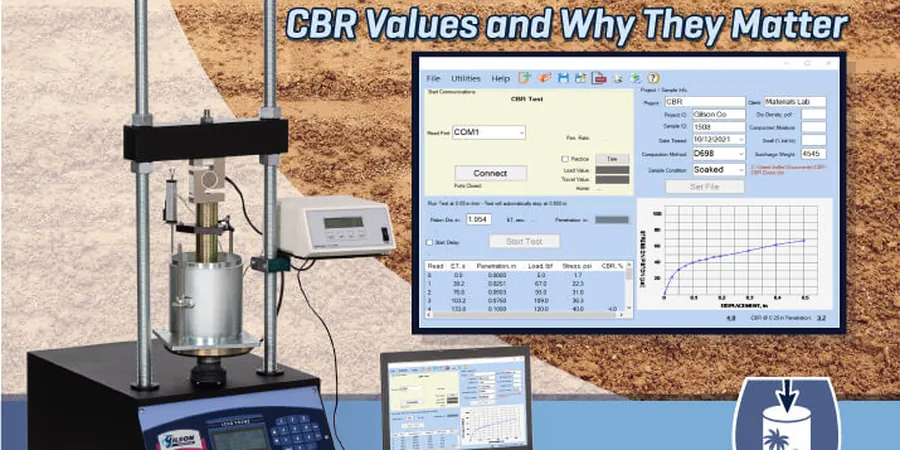
In Hobart's weathered dolerite, soaked CBR values can drop 40 percent compared to unsoaked – a difference that changes pavement thickness by 50 mm or more.
Methodology and scope
Local considerations
We saw a subdivision access road in Kingston where the contractor assumed a design CBR of 10 percent based on a regional table. The actual subgrade was a wet, fine-grained silt with a soaked CBR of 2.8 percent. Within two winters, the pavement suffered longitudinal cracking and edge break. The repair cost was triple the original earthworks budget. That scenario repeats when the CBR study for road design is skipped or replaced with generic values. In Hobart's variable geology – from the sandy terraces of the Derwent to the clayey slopes of Mount Wellington – assuming is not an option. The test is straightforward, but the consequence of missing it is not.
Applicable standards
AS 1289.6.1.1, AS 1289.5.1.1, AS 1289.5.2.1, AUSTROADS Pavement Design Guide (2017)
Associated technical services
Field sampling and compaction verification
We extract undisturbed or remoulded samples from trial pits or compacted pads. Field density is checked before the CBR specimen is prepared.
Soaked and unsoaked CBR testing
Both conditions are run when the pavement design requires understanding of moisture sensitivity. Soaked values govern for unsealed shoulders and drainage-prone sections.
Classification and index testing
Particle size distribution, Atterberg limits, and moisture-density relationship are reported alongside the CBR value. This gives the pavement engineer a complete subgrade profile.
Design recommendation report
We deliver a technical report with the CBR results, the test conditions, and a clear design value for each pavement layer. The report references the relevant AS standards and AUSTROADS guidelines.
Typical parameters
Frequently asked questions
What is the difference between soaked and unsoaked CBR, and which one should I use for a road project in Hobart?
Soaked CBR simulates worst-case moisture after 4 days of immersion, representing saturated subgrade conditions. Unsoaked CBR tests the material at its as-compacted moisture. For Hobart roads exposed to rainfall or shallow groundwater, use soaked CBR for design. For sealed pavements with good drainage, unsoaked CBR may be acceptable but must be justified by the geotechnical engineer.
How does Hobart's geology affect CBR values for pavement design?
Hobart sits on a mix of Jurassic dolerite, Permian siltstone, and Quaternary alluvium. Dolerite-derived residual soils typically yield higher CBR (8-15 percent soaked) but are prone to rapid strength loss when wet. Estuarine silts near the Derwent estuary can drop below 4 percent soaked. Each geological unit requires its own CBR test – regional averages are unreliable.
What is the typical cost range for a CBR study for road design in Hobart?
A complete CBR study including sampling, compaction verification, soaked/unsoaked testing, and a design report typically costs between AU$280 and AU$520 per sample. The final price depends on the number of samples, site accessibility, and whether index testing is included. Contact us for a project-specific quote.