In Hobart, we often see that the Derwent Estuary's deep alluvial deposits and the underlying Permo-Triassic sedimentary rocks create a sharp contrast in ground stiffness within a single block. A standard footing design simply won't cut it here. Seismic foundation design in Hobart must account for these abrupt soil transitions and the region's moderate seismicity, where bedrock acceleration can reach 0.08g under AS/NZS 1170 loading. We integrate surface-wave testing with borehole data to define the site's shear-wave velocity profile, then apply equivalent-linear ground response analysis to size foundations that won't ratchet or tilt during the design earthquake. This approach has proven essential on recent multi-storey projects along the waterfront, where soft silty clays overlie weathered dolerite.
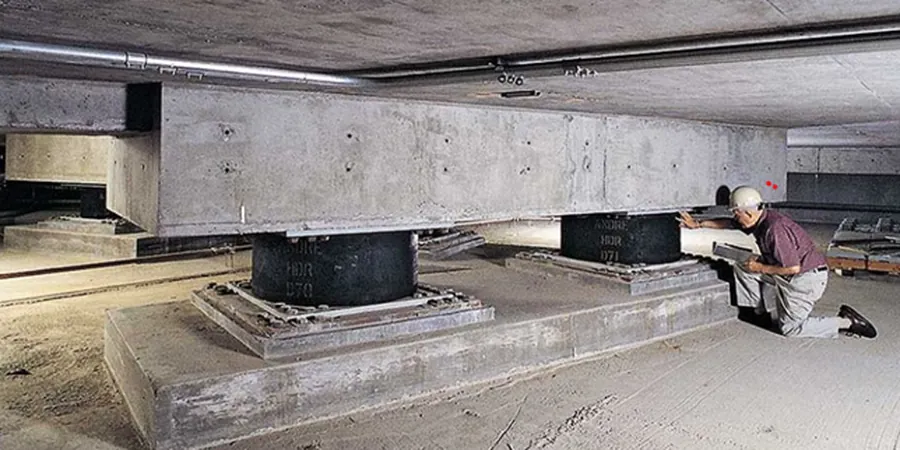
Hobart's Permo-Triassic bedrock can amplify ground motion by a factor of two in soft alluvium; ignoring that means foundation failure.
Methodology and scope
- Initial VS30 measurement via MASW to classify site class per ASCE 7 (typically Site Class D or C in the city center).
- Cyclic triaxial testing on undisturbed samples to evaluate liquefaction potential in the sandy lenses beneath the CBD.
- Limit-equilibrium bearing capacity checks using strength reduction factors from AS 4678, with a target factor of safety ≥ 2.0 under seismic load.
Local considerations
The biggest risk we encounter in Hobart is the presence of loose to medium-dense sand layers within the estuarine sequence that can liquefy under moderate shaking. Our crew uses a 63.5 kg SPT hammer to drive a split-spoon sampler at 1.5 m intervals, recording blow counts that feed into the Youd-Idriss 2001 liquefaction triggering curves. When N-values fall below 15 in saturated sands below the water table, we recommend ground improvement — typically deep soil mixing or vibro-replacement stone columns — before any seismic foundation design in Hobart proceeds. Without this step, a multi-storey building could experience differential settlement of 100 mm or more during a design-level event, compromising structural integrity.
Applicable standards
AS 1726 (geotechnical site investigations, 2017), AS/NZS 1170.4 (structural design actions – earthquake loads, 2007), AS 4678 (earth-retaining structures, 2002), AS 1289.6.3.1 (standard test method for SPT)
Associated technical services
Site-Specific Ground Response Analysis
1D equivalent-linear analysis using SHAKE2000 or DeepSoil, calibrated with local VS30 and cyclic triaxial data, to produce acceleration response spectra at foundation level.
Liquefaction Potential Assessment
SPT- and CPT-based triggering evaluation per NCEER 1998/Youd-Idriss, plus cyclic resistance ratio (CRR) curves for Hobart's sandy layers.
Foundation Stiffness and Kinematic Interaction
Winkler spring stiffness matrices for mats, footings, or pile caps under seismic loading, including pile-group effects and free-field displacement.
Seismic Bearing Capacity and Sliding Checks
Limit-equilibrium and finite-element (Plaxis 2D) analysis for shallow and deep foundations, with strength reduction factors from AS 4678 and ACI 543R.
Typical parameters
Frequently asked questions
What is the typical PGA value used for seismic foundation design in Hobart?
For ordinary structures (Importance Level 2) with a 500-year return period, the peak ground acceleration on rock is 0.08g per AS/NZS 1170.4. Soil amplification can bring this to 0.16g or higher on soft alluvium, so a site-specific response analysis is always recommended.
How does Hobart's geology affect foundation design under seismic loads?
The Derwent Estuary's alluvial sequence includes loose sand layers that may liquefy, while the underlying Permo-Triassic dolerite and sandstone provide competent bearing but can cause differential stiffness. Our design accounts for these transitions by using a layered soil profile with modulus reduction curves from cyclic triaxial testing.
What factor of safety is required for shallow foundations in Hobart under seismic conditions?
AS 4678 recommends a minimum factor of safety of 2.0 against bearing capacity failure under seismic loading, using a reduced shear strength (c and phi reduced by a strength reduction factor of about 1.25). For sliding, we target FS ≥ 1.5.
How much does a seismic foundation design study cost in Hobart?
The cost typically ranges between AU$2,070 and AU$6,060, depending on the number of boreholes, laboratory tests (cyclic triaxial, resonant column), and the complexity of the numerical analysis. We provide a fixed-price quote after reviewing the project scope and site conditions.