The Proctor test, defined under AS 1289.5.1.1 (Standard) and AS 1289.5.2.1 (Modified), establishes the relationship between moisture content and dry density for a given compactive effort. In Hobart, where the Derwent Estuary alluvial deposits and Quaternary clays dominate the shallow subsurface, achieving the specified compaction parameters is critical for structural fill and road subgrade performance. The test determines the optimum moisture content (OMC) and maximum dry density (MDD) for each soil type, providing a baseline that directly controls field compaction control, particularly when working with the variable gravelly clays and sandy silts common in the greater Hobart area. Following AS 1726, the laboratory procedure must be matched to the expected field compactive energy, which for deep fills along the Eastern Shore typically requires the Modified Proctor method. Before placing fill, a granulometry analysis is performed to size the material, and the Atterberg limits are measured to assess plasticity, ensuring the compaction target is realistic for the fine fraction.
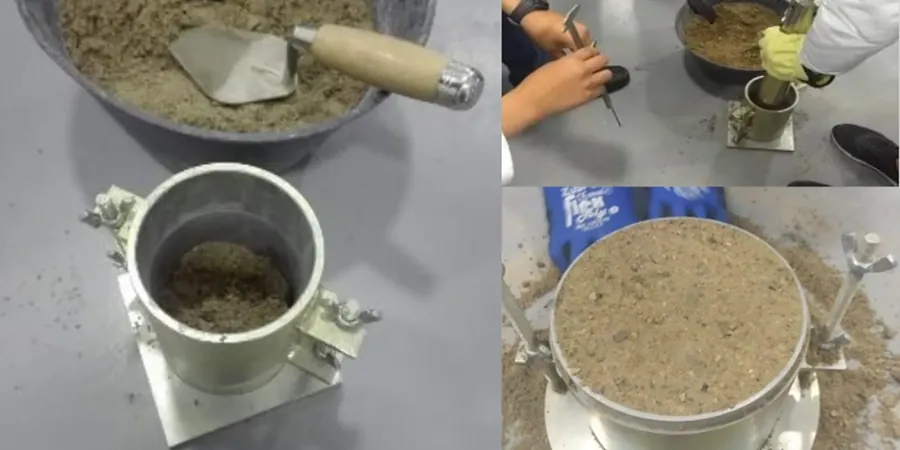
For Hobart's dolerite-derived fills, the Modified Proctor method typically yields an optimum moisture content 2–3% lower than Standard, requiring tighter field moisture control.
Methodology and scope
- sieving the sample through a No. 4 sieve (4.75 mm) for fine-grained soils, or through 3/4-inch (19 mm) for coarser materials,
- mixing five or more moisture increments spanning the expected OMC range,
- compacting each increment into a standard 4-inch or 6-inch mold,
- measuring the wet density, oven-drying to obtain moisture content, and plotting the compaction curve.
Local considerations
A common oversight in Hobart is using Standard Proctor results for fills that will experience heavy compaction in the field. The lower energy level of the Standard method can produce an OMC that is too high, leading to a dry density target that is unachievable under Modified field conditions. Conversely, requiring Modified Proctor on a fill that will only be lightly compacted can result in a specification that is economically wasteful, as achieving the higher MDD demands additional passes and moisture conditioning. The risk is amplified in the variable colluvial soils of the Wellington Park foothills, where the fine fraction can shift between silt and clay within a single borrow pit; without a Proctor test matched to the actual material, the density control becomes unreliable. Always pair the Proctor test with a grain size distribution to confirm that the sample tested is representative of the material being placed.
Explanatory video
Applicable standards
AS 1289.5.1.1 (Standard Proctor), AS 1289.5.2.1 (Modified Proctor), AS 1289.5.1.1 (Standard compaction test), AS 1289.5.2.1 (Modified compaction test)
Associated technical services
Standard Proctor (AS 1289.5.1.1)
Performed on soils passing the 19 mm sieve, using a 4-inch mold with three layers. Reported parameters include OMC, MDD, and the complete compaction curve. Suitable for residential fills, light-traffic pavements, and general earthworks in Hobart's suburban developments.
Modified Proctor (AS 1289.5.2.1)
Higher compactive effort applied to five layers in a 4-inch or 6-inch mold, depending on particle size. Used for road subgrades, heavy-duty pavements, and structural fill beneath commercial buildings in the Hobart CBD and industrial zones.
Typical parameters
Frequently asked questions
What is the difference between Standard and Modified Proctor tests?
The Standard Proctor (AS 1289.5.1.1) uses a 5.5 lb hammer dropped 12 inches in three layers, while the Modified Proctor (AS 1289.5.2.1) uses a 10 lb hammer dropped 18 inches in five layers. The Modified method delivers about 4.5 times the compactive energy, resulting in a higher maximum dry density and a lower optimum moisture content. The choice depends on the expected field compaction effort.
How much does a Proctor test cost in Hobart?
The typical cost for a Standard or Modified Proctor test in Hobart ranges from AU$170 to AU$320 per sample, depending on the number of moisture increments and whether a re-test is needed. For large projects with multiple samples, volume discounts can apply. Contact us for a quote specific to your project scope.
Can the Proctor test be performed on gravelly soils common in Hobart?
Yes, but the procedure must use the larger 6-inch mold (1/13.33 ft³) when particles up to 19 mm are present, as per AS 1289.5.2.1. For material with particles larger than 19 mm, the test is performed on the fraction passing the 19 mm sieve, and the oversize correction is applied to the MDD using the replacement method. The dolerite gravels in Hobart often require this correction.
How is the Proctor test used to control field compaction?
The laboratory-derived OMC and MDD serve as the target parameters. Field density tests, such as the sand cone or nuclear gauge, measure the in-place wet density and moisture content. The dry density is calculated and compared to the MDD, typically requiring 95% to 98% of MDD depending on the specification. The moisture content must be within ±2% of the OMC to achieve the required density.