Hobart grew on the banks of the Derwent estuary, where 19th-century wharves and warehouses were built over soft estuarine clays. Those same compressible silts and peats still challenge modern developments in Sullivans Cove and the waterfront precinct. Stone column design offers a practical solution: dense gravel columns act as vertical drains and stiff inclusions, accelerating consolidation while increasing bearing capacity. For sites underlain by thick alluvium, this method avoids deep piling costs. Before specifying columns, we typically run a [MASW survey](/masw-vs30/) to profile shear-wave velocity contrasts across the site and correlate with SPT data from adjacent boreholes. The combination of geophysics and direct testing produces a reliable design model for Hobart's variable ground conditions.
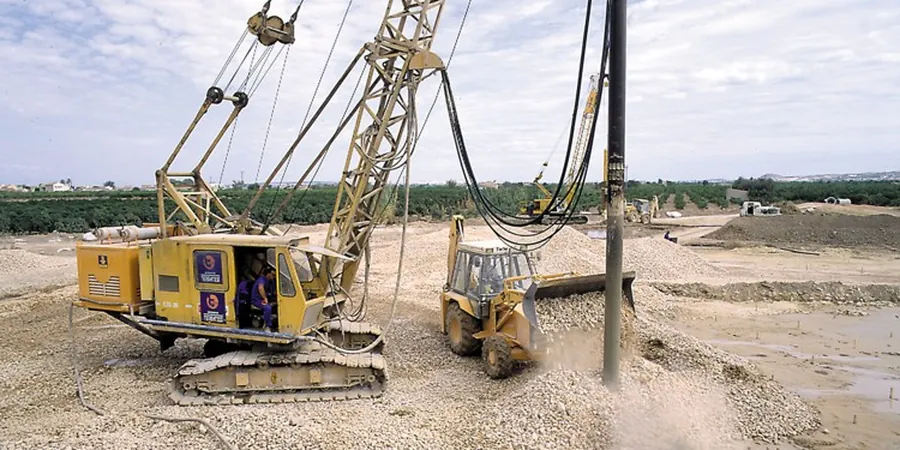
Stone columns reduce settlement by up to 60 % in Hobart's estuarine clays when designed with area replacement ratios of 18–25 %.
Methodology and scope
- Column diameter and spacing based on area replacement ratio (typically 15–25 %)
- Skin friction and end-bearing from CPT and triaxial data
- Drainage capacity to accelerate consolidation under surcharge
Local considerations
A vibro-probe penetrates the clay under its own weight and compressed air. The rig operator watches the ammeter: if current draw spikes, the column has hit a boulder or stiff dolerite float. In Hobart's Battery Point area, these glacial erratics are common. Forcing the probe through them can damage equipment and create voids. We mitigate this by pre-drilling obstructions with a rotary head before stone column installation. Another risk is lateral squeeze in very soft clays — if column spacing is too tight, the ground heaves outward instead of compacting. Our design checks include bearing capacity of the untreated matrix and limiting the replacement ratio to avoid over-stressing adjacent columns.
Applicable standards
AS 4678:2002 Earth-retaining structures (design guidance), AS 1726:2017 Geotechnical site investigations, FHWA NHI-16-072 (stone column design manual)
Associated technical services
Vibro-replacement design for soft clays
Full design package including column layout, aggregate specification, and settlement analysis using Priebe's method. Suitable for estuarine silts, peats, and soft alluvium up to 15 m depth. Output includes working drawings and installation tolerances.
Rammed aggregate pier design for mixed fills
Designed for variable ground – fill over dolerite or alluvium. Uses a dry, top-feed method with controlled energy per lift. Ideal for low-rise structures where vibro-replacement is not feasible due to access or vibration limits.
Typical parameters
Frequently asked questions
What is the typical cost range for stone column design in Hobart?
The cost for a stone column design package in Hobart typically ranges between AU$2.320 and AU$7.000, depending on site complexity, number of columns, and required laboratory testing. This covers layout design, settlement analysis, and installation specifications. Variations apply for sites requiring additional CPT boreholes or load testing.
How deep can stone columns be installed in Hobart alluvium?
Vibro-replacement stone columns can reach depths of 12–15 m in Hobart's soft estuarine alluvium. The practical limit is governed by the probe's ability to penetrate dense sand lenses or dolerite boulders. For deeper treatment, a combination of stone columns and vertical drains is sometimes specified.
What soil conditions make stone columns unsuitable in Hobart?
Stone columns are not recommended in highly organic peats with moisture content above 200 % or in ground with abundant large boulders (e.g., glacial till in the foothills). In those cases, deep soil mixing or driven piling may be more appropriate. We always verify site conditions with a geotechnical investigation before proceeding.