In Hobart, where the Derwent estuary meets a landscape shaped by glacial till and alluvial deposits, the permeability of the underlying soil can vary dramatically over a few metres. We often see projects halted mid-excavation because perched water tables appear where none were expected. That is why a laboratory permeability test — either falling head for fine soils or constant head for granular materials — is a non-negotiable early step. It gives engineers the saturated hydraulic conductivity value (k) needed to size drainage blankets, design cut-off walls, or plan dewatering strategies. In a city that sits on a mix of Permian mudstone, Tertiary basalt, and Quaternary gravels, you cannot guess the flow regime; you have to measure it under controlled conditions.
A measured k value of 2.3 × 10⁻⁷ m/s changed the drainage design entirely — guesswork would have cost time and money.
Methodology and scope
Local considerations
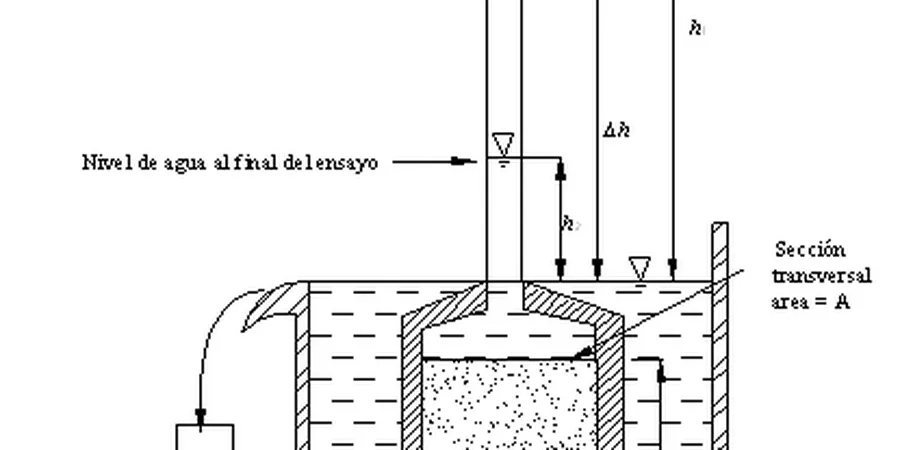
The falling head permeameter we use in Hobart is a rigid-wall cell with a graduated standpipe mounted on a vibration-free bench. For constant head tests, a fully automated triaxial system applies controlled flow and measures effluent volume with ±0.01 mL resolution. The biggest risk in the lab is incomplete saturation: if air remains trapped in the sample, the measured k will be artificially low. We mitigate this by flushing with de-aired water under vacuum for at least 24 hours before testing. On site, the risk is sample disturbance during extrusion — a disturbed sample destroys the soil fabric and invalidates the permeability result. That is why our field team uses thin-walled Shelby tubes and seals every sample immediately.
Applicable standards
AS 1289.6.7.1 – Falling head permeability, AS 1289.6.7.1 – Constant head permeability, AS 1726 – Geotechnical site investigations
Associated technical services
Falling Head Permeability Test
Designed for fine-grained soils (silts, clays, clayey sands) where flow is slow. The test measures the time for water to fall between two marks on a standpipe, giving a direct k value for low-permeability strata. Suitable for foundation drainage design and dam core evaluation.
Constant Head Permeability Test
Used on granular soils (sands, gravels) that drain quickly. Water flows through the sample at a steady hydraulic gradient while the outflow is measured. Results are critical for retaining wall backfill, filter layer sizing, and dewatering system design.
Typical parameters
Frequently asked questions
What is the difference between falling head and constant head permeability tests?
Falling head is used for low-permeability soils (k < 10⁻⁵ m/s) where water moves slowly; the head drops over time and the rate of drop gives the k value. Constant head is for high-permeability soils (k > 10⁻⁵ m/s) where a steady flow is maintained and the volume collected per unit time is measured directly.
How much does a laboratory permeability test cost in Hobart?
A standard falling head or constant head test in Hobart typically ranges between AU$730 and AU$1,100 per sample, depending on saturation method, number of confining pressures, and whether a triaxial cell is required. Contact us for a quote tailored to your project scope.
Can you test permeability on disturbed samples?
No — permeability is highly sensitive to soil fabric, voids, and density. Only undisturbed tube samples (Shelby tubes, 50–100 mm diameter) give reliable results. Disturbed samples lose their natural structure and produce k values that may be orders of magnitude off.