Hobart sits on a mix of Permo-Triassic sedimentary rocks overlain by Quaternary alluvial and colluvial deposits, especially along the Derwent River estuary. These soils range from stiff clays to loose sands, making triaxial testing essential for reliable foundation design. The triaxial test directly measures undrained shear strength, effective stress parameters, and consolidation characteristics under controlled drainage conditions. For projects near the waterfront or on the eastern shore, knowing how the ground will behave under load prevents costly surprises. The laboratory follows AS 1726:2017 for geotechnical site investigations and AS 1289.6.4.2 for consolidated undrained triaxial compression.
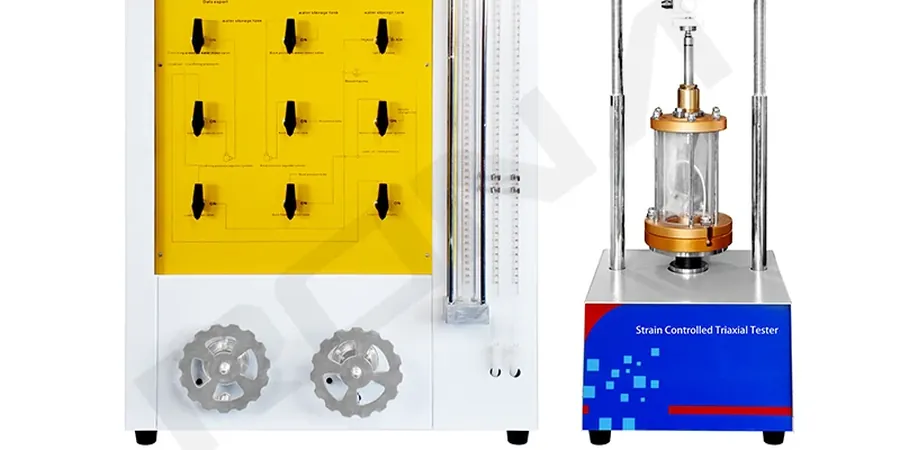
In Hobart's variable geology, triaxial testing gives the c' and phi' values that settlement and stability calculations rely on.
Methodology and scope
Local considerations
Comparing the firm clays of Battery Point with the loose fill on the Domain reveals why one-size-fits-all assumptions fail. In the city centre, old creek channels and uncontrolled fill create pockets of low-strength material. A triaxial test on a sample from the Domain might show Su below 40 kPa, whereas a Battery Point clay can exceed 100 kPa. Without that data, a foundation designed for the stronger soil would settle unevenly in the weaker zone. The test picks up these differences before concrete is poured. For slopes along the Wellington Park foothills, the effective stress parameters from CIU tests are critical for stability analysis against shallow sliding.
Applicable standards
AS 1289.6.4.2 (Consolidated Undrained Triaxial), AS 1289.6.4.1 (Unconsolidated Undrained Triaxial), AS 1726:2017 (Geotechnical Site Investigations), AS 1289.6.4.1 (Soil Strength Tests)
Associated technical services
Consolidated Undrained (CIU) Triaxial
Full saturation, isotropic consolidation, and shearing under undrained conditions with pore pressure measurement. Delivers effective stress parameters (c', phi') and stress paths for advanced analysis. Ideal for embankment stability and deep foundations.
Unconsolidated Undrained (UU) Triaxial
Quick test on undisturbed specimens at in-situ moisture content. Provides undrained shear strength (Su) for immediate bearing capacity and rapid construction stages. Suitable for clay fills and temporary works.
Typical parameters
Frequently asked questions
What is the typical turnaround time for triaxial tests in Hobart?
A standard CIU test with three specimens takes around 5 to 7 working days from sample reception. UU tests are faster — usually 2 to 3 days. Rush services are available for critical path projects.
How do I choose between a UU and a CIU triaxial test?
Choose UU for short-term undrained strength — for example, during excavation or immediately after fill placement. Choose CIU when the soil will consolidate under load, such as under a permanent embankment or raft foundation. The CIU test gives effective stress parameters that allow you to model long-term behaviour.
What sample quality is required for triaxial testing?
Undisturbed tube samples from thin-walled Shelby tubes are standard. The tube diameter must be at least 70 mm to obtain a 50 mm specimen. Block samples are also accepted. All samples must be sealed and transported in a rigid container to avoid disturbance. Transport time from site to the Hobart lab should not exceed 48 hours.