Hobart sits on a complex mix of dolerite, Permian siltstone, and Quaternary alluvial deposits along the Derwent estuary. The Standard Penetration Test (SPT) per AS 1726-2017 remains the most widely used in-situ method here for determining soil strength and stratigraphy. Because groundwater levels fluctuate with the Derwent tide, the SPT provides a reliable way to measure relative density in sands and consistency in clays before any foundation design begins. Before drilling, the team often runs a georradar (GPR) survey to locate buried services and optimise borehole placement on congested urban sites.
In Hobart’s variable geology, the SPT provides the only direct measure of soil resistance that correlates with both bearing capacity and liquefaction potential.
Methodology and scope
Local considerations
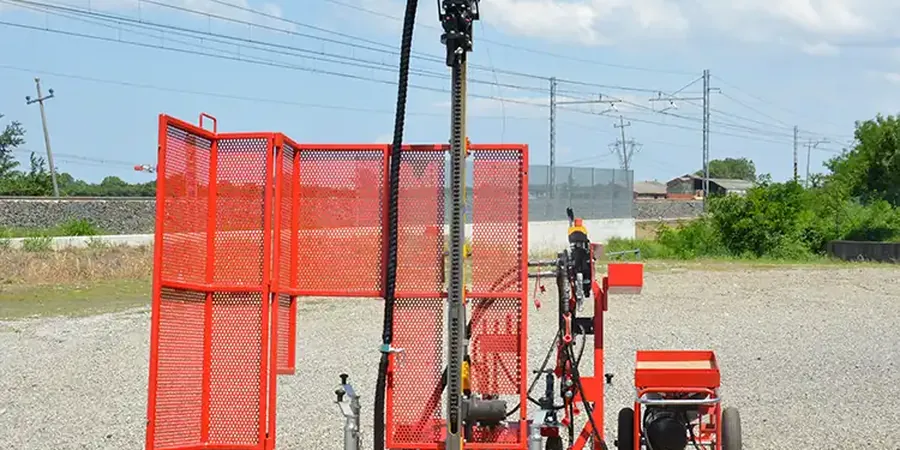
The SPT hammer and tripod assembly used in Hobart is a compact, skid-mounted unit weighing about 400 kg. It is handled by a two-person crew trained in manual handling protocols. The risk of a dropped hammer or cable whip is managed with a safety cage and daily equipment inspection. On steep dolerite slopes near Mount Wellington, the rig is stabilised with outriggers and tie-downs to prevent overturning. All operators hold current White Cards and site-specific inductions for Tasmanian construction sites.
Applicable standards
AS 1726-2017 Geotechnical Site Investigations, AS 1289.6.3.1 Standard Test Method for SPT, AS/NZS 1170.4 Structural Design Actions – Earthquake
Associated technical services
Borehole Drilling & SPT Execution
Hydraulic rigs capable of reaching 30 m in dolerite and alluvium. Split-spoon sampling at 1.5 m intervals or as specified.
N-value Logging & Reporting
Digital blow-count records with corrected N60 values for rod energy, overburden, and borehole diameter per AS 1726.
Sample Recovery & Lab Integration
Sealed, labelled samples delivered to laboratory for moisture content, Atterberg limits, and particle size distribution.
Seismic Site Classification
SPT-based Vs30 estimation using published correlations (Seed & Idriss, Ohta & Goto) for AS 1170.4 site sub-soil class.
Typical parameters
Frequently asked questions
What is the difference between SPT N-value and bearing capacity?
The N-value is a blow count that indicates soil relative density or consistency, not a direct bearing capacity. Engineers use empirical correlations (e.g., Meyerhof, Terzaghi) to convert N60 into allowable bearing pressure for foundation design. In Hobart, the local dolerite often gives N-values above 50, while soft estuarine clays may show N-values below 5. A geotechnical engineer must apply the appropriate correction for each stratum.
How much does an SPT investigation cost in Hobart?
A typical SPT borehole to 15 m depth with sampling and laboratory testing ranges from AU$950 to AU$1,240 per borehole. Costs depend on site access, number of tests, and whether the rig needs mobilisation from the eastern shore or the city centre. Multiple boreholes on the same property reduce the per-borehole rate.
Can SPT detect liquefaction potential in Hobart soils?
Yes. SPT-based liquefaction assessment follows the Youd & Idriss (2001) method (NCEER workshop). In Hobart, the main concern is loose saturated sands along the Derwent foreshore and in reclaimed land near the casino. N-values below 15 in clean sands with high groundwater are flagged for further cyclic testing. A full liquefaction hazard report includes SPT data, grain size curves, and cyclic stress ratio calculations.