A road widening project near the Derwent River hit a common snag: the existing subgrade was a highly plastic clay that turned into soup under any moisture increase. We specified lime stabilization to dry the material, reduce its plasticity index from 42 to 18, and create a working platform capable of supporting the new pavement layers. For deeper lifts where lime alone was insufficient, we followed with cement stabilization to achieve unconfined compressive strengths above 2.0 MPa at 7 days. The client avoided importing 4,500 cubic metres of fill. Before treating any site, we run a full suite of index tests — including Atterberg limits and grain size distribution — to tailor the binder dosage precisely. This approach has been applied to airport aprons, industrial slabs, and low-volume rural roads across the Hobart region.
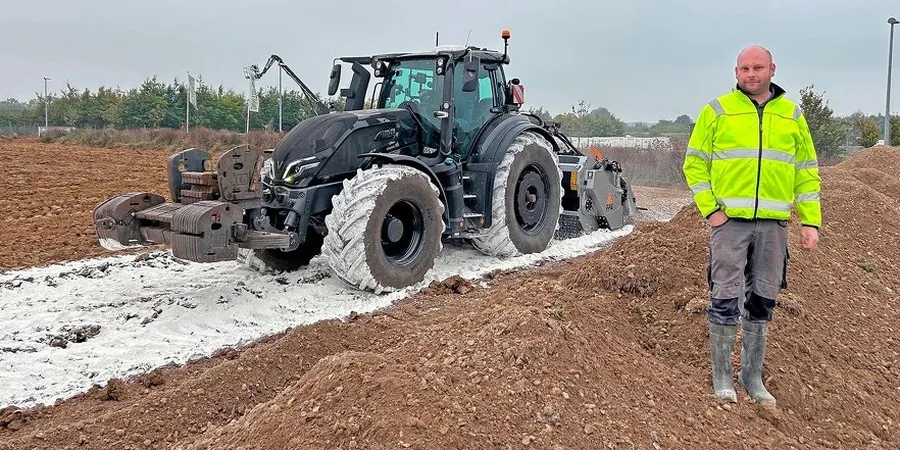
Lime reduces plasticity index from 42 to 18 in Hobart clays; cement delivers unconfined compressive strengths above 2.0 MPa at 7 days.
Methodology and scope
- Maximum dry density and optimum moisture content via modified Proctor (AS 1289.5.2.1)
- Unconfined compressive strength at 7 and 28 days on specimens cured at 25 °C
- California Bearing Ratio (CBR) of treated and soaked samples, often exceeding 80%
- Linear shrinkage reduction from 12% to below 3% after lime addition
Local considerations
The alluvial clays along the Derwent estuary contain smectite minerals that undergo significant volume change with moisture variation. If the stabilisation reaction is incomplete — often because the binder was under-dosed or mixing was uneven — the treated layer can swell and crack within two years, leading to pavement failure. Another hazard is delayed compaction: if the lime-treated soil is left uncovered for more than 24 hours in Hobart's humid conditions, carbonation can consume the available lime before it reacts with the clay. We mitigate both risks by enforcing a strict mixing window, using rapid moisture testing on site, and verifying the mellowing period with pH measurements above 12.4.
Applicable standards
AS 1726 – Geotechnical site investigations, AS 1289.5.2.1 – Modified Proctor compaction, AS 1289.6.1.1 – CBR determination, Austroads Guide to Pavement Technology Part 4E (lime/cement stabilisation), ISO 17025 – Laboratory accreditation
Associated technical services
Mix Design and Laboratory Testing
We prepare representative samples of the site soil and test binder dosages from 2% to 8% by dry mass. The program includes Atterberg limits, modified Proctor, unconfined compression, and soaked CBR to determine the optimum lime-cement blend for your project.
On-Site Quality Control
Our technicians supervise spreading, mixing, and compaction of the stabilised layer. We measure in-place density, moisture content, and pH throughout the process to confirm the design parameters are met. Reports are issued within 48 hours.
Long-Term Performance Monitoring
We install settlement plates and moisture sensors to track the behaviour of the treated layer over the first 12 months. This data validates the design assumptions and provides a baseline for pavement maintenance planning in Hobart's climate.
Typical parameters
Frequently asked questions
How long does the lime stabilisation process take before compaction can begin?
The mellowing period for lime-treated clay typically ranges from 2 to 24 hours, depending on the soil type and moisture content. In Hobart's cooler months, we often allow 12 to 18 hours for the lime to fully hydrate and flocculate the clay particles before final mixing and compaction.
What is the typical cost range for lime and cement stabilisation in Hobart?
For a standard road subgrade treatment, the cost ranges between AU$1,290 and AU$3,780, including mix design, materials, and on-site quality control. The final price depends on the treatment depth, binder dosage, and volume of material stabilised.
Can cement stabilisation be used on organic soils common near the Hobart waterfront?
Cement stabilisation is less effective on soils with organic content above 2% because organic matter interferes with hydration. We first test the organic content using the Walkley-Black method. If it exceeds 2%, we either pre-treat with lime or recommend a different ground improvement technique.
What thickness of stabilised layer is typically specified for residential driveways in Hobart?
For light residential traffic, we usually specify a 200 mm thick stabilised layer with a cement content of 3% to 5% by dry mass. The design is verified with a soaked CBR test to ensure the treated material reaches at least 80% of the maximum dry density.