In Hobart, the widespread estuarine deposits of the Derwent River delta present a classic challenge for preloading design without surcharge. Under AS 4678:2002 for earth-retaining structures and AS 1726:2017 for geotechnical site investigations, we model consolidation rates using Terzaghi's one-dimensional theory with site-specific oedometer data. Hobart's typical soft clay profiles, with natural moisture contents exceeding 80% in some tidal flats, require careful staged loading to avoid bearing failure during fill placement. Our design integrates settlement plates and piezometer arrays to verify pore pressure dissipation in real time, ensuring that the target post-construction settlement — often limited to 25 mm for critical infrastructure — is achieved before pavement or foundation works commence.
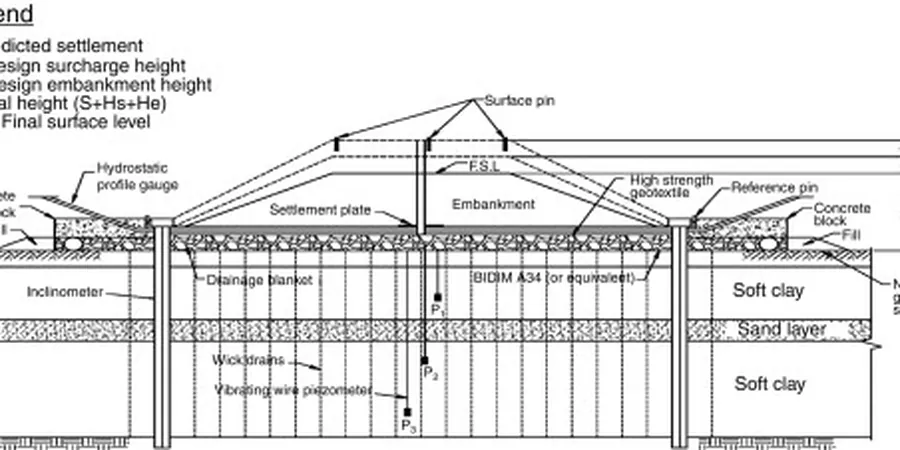
For Hobart's estuarine clays, preloading without surcharge typically achieves 90% primary consolidation within 6 to 18 months, depending on cv and drainage path length.
Methodology and scope
Local considerations
The primary risk in Hobart's preloading projects is underestimating the lateral displacement of soft ground beneath the fill, which can damage adjacent services or existing structures. We use inclinometer casings installed to depths of 15–20 m to monitor horizontal movements, and we limit the fill placement rate to 0.3 m per week in the most sensitive zones. Another common issue is the presence of thin sand lenses within the clay profile — these can act as preferential drainage paths but may also cause differential settlement if their thickness varies laterally. Our field testing program includes CPTu soundings to identify these lenses and to calibrate the consolidation model for the specific stratigraphy of each site in Hobart.
Applicable standards
AS 4678:2002 – Earth-retaining structures, AS 1726:2017 – Geotechnical site investigations, AS/NZS 1170.0:2002 – Structural design actions, general principles
Associated technical services
Site Investigation & Parameter Derivation
Boreholes with undisturbed sampling, oedometer testing, and CPTu soundings to determine cv, mv, and preconsolidation pressure for the estuarine clay profile.
Staged Fill Design & Monitoring Plan
Detailed fill sequencing with settlement plates, pneumatic piezometers, and inclinometers to verify consolidation progress and maintain stability.
Consolidation Modeling & Settlement Prediction
Finite-difference or analytical Terzaghi models calibrated to Hobart's specific soil data, with predictions for both primary and secondary compression.
Verification Testing & Load Removal Criteria
Post-consolidation CPTu and vane shear tests to confirm strength gain, plus a formal report certifying that target settlements have been achieved.
Typical parameters
Frequently asked questions
How long does preloading without surcharge typically take in Hobart?
For the estuarine clays of the Derwent delta, with a cv of 1–3 m²/year and a 4 m drainage path, 90% primary consolidation is usually reached within 10–14 months. Sites with sand lenses or higher cv can be faster, while deeper clay layers may extend the period.
Can preloading without surcharge handle differential settlement in variable fill?
Yes, but careful staging is required. Our design uses multiple settlement plates across the site to detect differential movement early. If lateral variability is high, we recommend combining preloading with vertical drains to equalize pore pressures more uniformly.
What happens if pore pressures don't dissipate on schedule?
We maintain a contingency in the fill placement schedule. If piezometers show slower-than-expected dissipation, we extend the wait period or add lightweight fill to reduce the load increment. In extreme cases, we switch to a surcharge design, but this is rare in Hobart's geology.
What is the typical cost range for a preloading design study in Hobart?
A comprehensive preloading design including site investigation, instrumentation, and monitoring typically ranges from AU$1,000 to AU$3,630, depending on site area, number of boreholes, and monitoring duration. Final cost is confirmed after the initial field program.