Hobart's waterfront and low-lying suburbs sit on deep alluvial deposits from the Derwent River. These soft clays and silts have high moisture content and low permeability, which makes traditional consolidation extremely slow. Prefabricated vertical drains accelerate settlement by providing short horizontal drainage paths, and before we design the PVD layout we always run a permeability field test to confirm the coefficient of horizontal consolidation. Without that baseline, any drain spacing calculation is guesswork. Our team has completed PVD designs for wharf extensions, road embankments, and residential subdivisions across Greater Hobart, working with contractors who need tight schedules and predictable outcomes.
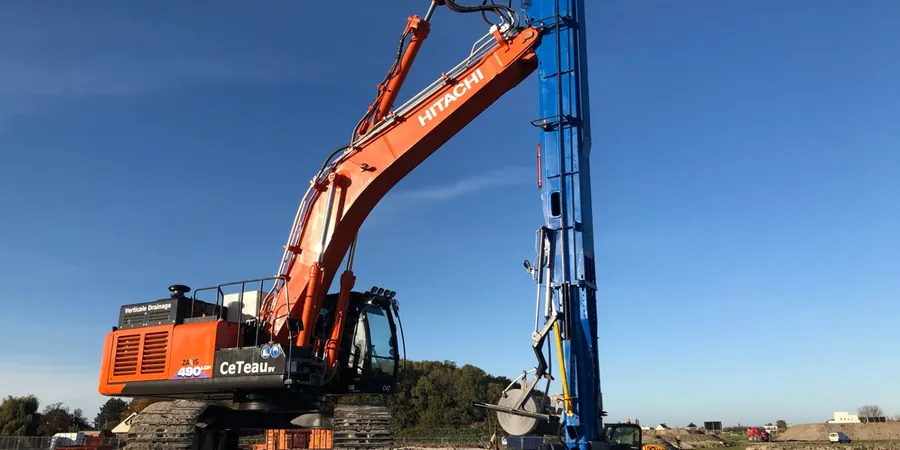
Without site-specific ch values from field permeability tests, PVD spacing calculations in Hobart's estuarine clays are unreliable and can delay projects by months.
Methodology and scope
- Drain diameter and discharge capacity (typically 40–100 mm wide strips)
- Spacing from 1.0 m to 2.5 m depending on consolidation window
- Smear zone correction from Mandel–Salençon theory
- Vertical drain length to penetrate the full compressible layer
Local considerations
In Hobart, many sites have a thin crust of desiccated clay over deep soft layers. If you install PVDs through that crust without pre-augering, the mandrel can smear the filter and reduce drain capacity by up to 40%. We always specify a pilot hole or use a sacrificial mandrel tip for the first metre. Another local issue: the water table sits within 0.5 m of the surface near the waterfront. That drives the need for a working platform and careful dewatering before drain installation. Skipping these steps leads to clogged drains and stalled consolidation.
Applicable standards
AS 1726:2017 Geotechnical Site Investigations, AS 4678:2002 Earth Retaining Structures, AS/NZS 1170.0:2002 Structural Design Actions (general principles)
Associated technical services
PVD Layout and Spacing Design
Full design report including drain type selection, triangular or square grid layout, spacing optimisation based on ch/cv from laboratory and field tests, and settlement vs. time curves. We deliver CAD-ready drain layout plans and installation specifications.
Performance Monitoring and Verification
Installation of settlement plates, piezometers, and inclinometers to verify consolidation rate against design predictions. We provide monthly progress reports with back-analysis of the coefficient of consolidation and recommendations for surcharge adjustment.
Typical parameters
Frequently asked questions
How long does it take for PVDs to achieve 90% consolidation in Hobart's soft clays?
Depending on drain spacing and clay layer thickness, typically 3 to 8 months. For a 10 m thick layer with 1.5 m triangular spacing, we usually reach 90% consolidation within 4 months under a surcharge of 1.5 times the design load.
Can PVDs be used in Hobart's fill areas near the city centre?
Yes, but we need to confirm that the fill is clean (no large debris or stiff layers) and that the underlying natural clay is thick enough to justify the cost. In areas like the Sullivans Cove precinct, we have designed PVDs through up to 4 m of fill into 12 m of soft clay.
What is the typical cost range for a PVD design in Hobart?
The design and specification phase typically ranges between AU$1.130 and AU$3.640, depending on site complexity, number of boreholes, and whether field permeability tests are needed. Installation costs are additional and vary by contractor and drain length.
How do you account for the smear zone in PVD design?
We apply the Mandel–Salençon reduction to the horizontal permeability within the smear zone, using a ratio ds/dw of 2.0 to 3.0. The actual value is calibrated from field dissipation tests or laboratory model tests on the specific mandrel geometry proposed.