Hobart sits on a complex mix of Quaternary alluvium and residual dolerite-derived clays. The city's rainfall, averaging around 600 mm annually, saturates these soils rapidly. When dry, they appear competent. But once wetted, the open fabric collapses. That is the risk of collapsible soils in Hobart. An accurate evaluation identifies the metastable structure before construction begins. Combining field inspection with a laboratory triaxial test helps confirm collapse potential under load. Without this data, a foundation may settle unevenly after the first wet season.
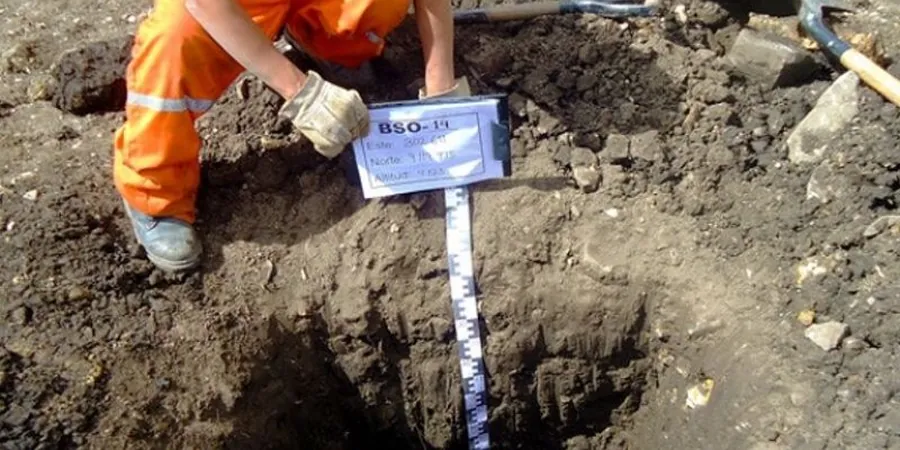
A hard crust of clay can mask a collapsible layer just a meter below – the collapse triggers when water breaks weak interparticle bonds.
Methodology and scope
- Collapse index (Ic) per AS 1289.7.1
- Dry density and moisture content before and after wetting
- Void ratio at natural state and at saturation
- Clay mineralogy via X-ray diffraction
Local considerations
Compare a site in Sandy Bay with one in Glenorchy. Sandy Bay's well-drained dolerite slopes rarely show collapse. But Glenorchy's alluvial flats, with silty clays and fine sands, often register Ic values above 1.5 %. That difference can mean 50 mm of differential settlement after heavy rain. A proper collapsible soil evaluation in Hobart distinguishes these zones clearly. We recommend testing at every change in soil type, especially near drainage channels or areas with high groundwater fluctuation.
Applicable standards
AS 1726-2017, AS 1289.7.1 (Standard Test Method for Measurement of Collapse Potential of Soils), Australian Geomechanics Society – Landslide Risk Management (2007)
Associated technical services
Field Sampling & Double-Oedometer Testing
Undisturbed block samples are taken from test pits at foundation depth. The double-oedometer test measures compression at natural moisture and after saturation, giving a direct collapse index per AS 1289.7.1.
Collapse Risk Mapping & Foundation Recommendations
Using Ic values and soil profiles, we generate a collapse risk map for the site. Recommendations include pre-wetting, compaction control, or deep foundation alternatives to bypass collapsible layers.
Typical parameters
Frequently asked questions
What is the difference between a collapsible soil and an expansive soil?
Collapsible soils lose volume when wetted, while expansive soils swell. Both can damage foundations, but the mechanism and testing differ. Collapsible soils require oedometer tests at two moisture conditions; expansive soils need free-swell and swell-pressure tests.
How much does a collapsible soil evaluation in Hobart typically cost?
Prices range between AU$1,180 and AU$3,350 depending on site access, number of test pits, and laboratory testing required. A single test pit with double-oedometer test falls at the lower end; multi-pit projects with mineralogy analysis reach the upper end.
Which Hobart suburbs are most prone to collapsible soils?
Glenorchy, Moonah, and parts of Derwent Park sit on alluvial silts and clays with moderate to high collapse potential. Sandy Bay, Battery Point, and Mount Stuart generally have stable residual soils from dolerite weathering.
Can I build directly on a collapsible soil after treatment?
Yes. Pre-wetting, dynamic compaction, or chemical stabilisation can reduce collapse potential. However, treatment must be verified by post-treatment testing. We recommend a second round of oedometer tests on treated samples to confirm Ic values below 0.5 %.
What standard does the evaluation follow in Australia?
We follow AS 1726-2017 for site investigation and AS 1289.7.1 for laboratory collapse testing. The Australian Geomechanics Society guidelines also inform risk classification and reporting.