Hobart sits on the foothills of Mount Wellington, where slopes of 15 to 30 degrees are common across suburbs like West Hobart and Sandy Bay. This topography makes slope stability analysis a critical step before any excavation or road cut. Our geotechnical team has assessed dozens of sites in the city, from residential developments on Battery Point to commercial projects along the Derwent estuary. We combine field reconnaissance with laboratory testing of soil shear strength to calculate factors of safety under both static and seismic conditions. The analysis follows AS 4678 and references FHWA-NHI-05 guidelines for reinforced soil slopes. For deep cuts on steep lots we often recommend a monitoring plan for slope movement to track creep and pore pressure changes over time.
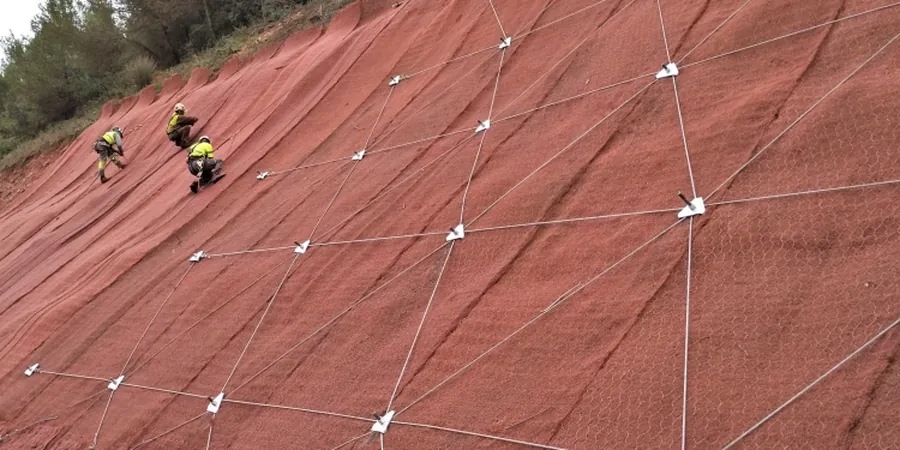
A slope stability check before excavation can prevent thousands in remedial costs — we've seen it save projects in Sandy Bay and South Hobart.
Methodology and scope
Local considerations
Hobart's climate brings wet winters with rainfall exceeding 600 mm between June and August. Saturated soils increase pore pressure and reduce effective stress, triggering shallow landslides on fill slopes. The risk is highest in areas underlain by Jurassic dolerite colluvium, which can lose strength rapidly when water content rises. On sandstone slopes in the city's north, differential weathering creates weak layers that act as slip planes. We address these risks by running sensitivity analyses for varying water tables and including a seismic coefficient of 0.08g per AS 1170.4. A slope that passes static conditions can still fail during a moderate earthquake if the soil is loose or the geometry is steep.
Applicable standards
AS 4678-2002 (Earth-retaining structures), FHWA-NHI-05-089 (Mechanically Stabilized Earth Walls), AS 1170.4-2007 (Earthquake actions), AS 1289.6.2.2 (Direct shear test)
Associated technical services
Preliminary Slope Assessment
Walkover survey, photo documentation, and ranking of failure potential using the Geotechnical Slope Hazard Matrix. Suitable for residential lots and small subdivisions.
Limit Equilibrium Analysis
2D stability modeling with Bishop and Spencer methods. We test multiple failure surfaces and provide a factor of safety for design. Output includes critical slip surface location and required reinforcement.
Seismic Slope Stability
Pseudostatic analysis with horizontal seismic coefficient per AS 1170.4. For high-risk sites we also run a Newmark sliding block analysis to estimate permanent displacement.
Remediation Design Support
We calculate required soil nail lengths, tieback forces, or berm dimensions to bring the factor of safety above 1.5. Our team coordinates with structural engineers for retaining wall integration.
Typical parameters
Frequently asked questions
How much does a slope stability analysis cost in Hobart?
The cost ranges between AU$1,710 and AU$5,660 depending on the number of sections analyzed, the need for laboratory shear tests, and whether seismic loading is included. A single-section residential assessment with two boreholes and direct shear testing typically falls at the lower end. Larger commercial projects with multiple cross-sections and triaxial testing sit at the upper end. We provide a fixed price after reviewing the site plan and scope.
When is a slope stability analysis required in Hobart?
Hobart City Council typically requires a geotechnical report with slope stability analysis for any cut or fill exceeding 2 meters in height, or for buildings within 10 meters of a slope steeper than 1 in 3. It is also mandatory for subdivisions in landslide-prone zones identified in the Hobart Local Provisions Schedule. Even if not required by council, we recommend it for any site with visible creep, tension cracks, or prior slips.
What soil tests are needed for slope stability analysis?
The minimum set includes classification tests (moisture content, Atterberg limits, particle size distribution) and direct shear or triaxial CU tests on undisturbed samples. For dolerite colluvium we also run a consolidated drained triaxial test to capture the residual strength. Pore pressure parameters are obtained from piezometer readings or estimated using the Ru coefficient from published correlations for Tasmanian soils.