Hobart sits on a mix of Permian mudstone, Triassic sandstone, and Quaternary alluvial deposits along the Derwent estuary. The water table can be shallow near the waterfront, and the residual soils on the foothills of Mount Wellington often exhibit high plasticity and variable strength. For projects where access is tight or loads are moderate, micropile design offers a practical alternative to driven piles. We typically start with a borehole investigation with SPT to profile the soil layers and confirm the bearing strata before sizing the micropile array. The combination of thin lithified layers and soft clays requires careful load transfer analysis, which is why we run site-specific design checks for every Hobart job.
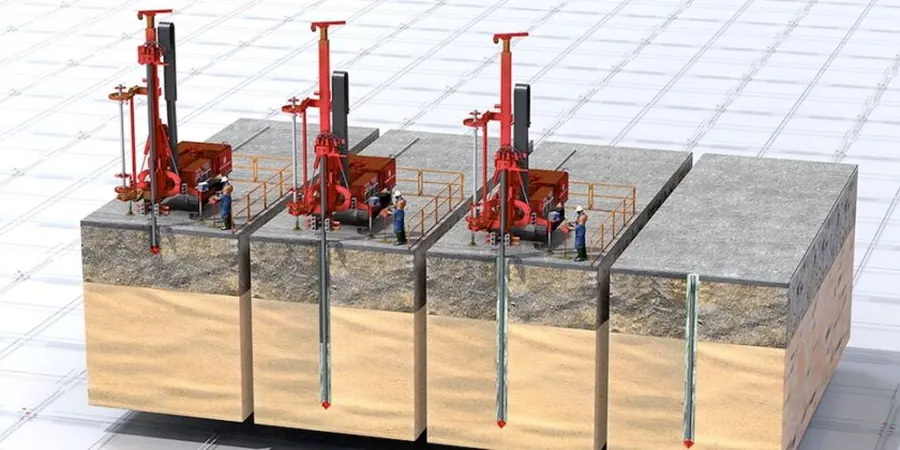
Micropile design in Hobart must account for lateral variations from river terraces to colluvium, with probe holes and borelog correlation driving capacity estimates.
Methodology and scope
Local considerations
Urban development in Hobart expanded rapidly during the 19th century, with many buildings constructed directly on shallow foundations over variable fill. The 1960s saw infill of tidal flats around the waterfront, creating pockets of soft compressible ground. If micropile design skips a proper ground model, differential settlement can occur between new structures and adjacent heritage masonry. We mitigate this by running a phased investigation: first a desk study of historical maps and borehole records, then targeted test pits or probe holes to validate the subsurface profile before finalizing the pile layout.
Applicable standards
AS 1726 – Geotechnical site investigations, AS 4678 – Earth-retaining structures, AS/NZS 1170 – Structural design actions, NATA accreditation for laboratory testing
Associated technical services
Micropile Design for Foundation Support
We size micropile arrays for new buildings, extensions, and underpinning of existing structures. The process includes load estimation based on column/wall reactions, selection of pile diameter and reinforcement, and verification of geotechnical capacity against borehole data.
Micropile Design for Slope Stabilization
For hillside sites in Hobart where shallow slides or creep are a concern, we design micropile walls as passive barriers. The design accounts for soil shear strength parameters from triaxial testing and calculates required pile spacing and embedment depth to resist driving forces.
Typical parameters
Frequently asked questions
How does micropile design differ from conventional pile design for Hobart soils?
Micropiles are smaller in diameter and rely more on skin friction along the grout-to-soil interface. In Hobart’s weathered sandstone and clay profiles, we typically see higher unit skin friction than in driven piles, but end-bearing capacity is often limited by the presence of soft zones. The design method per AS 1726 uses factored shaft resistance from borehole SPT data rather than end-bearing alone.
What site data do you need to start a micropile design in Hobart?
We need at least one borehole with SPT logs to 1.5 times the estimated pile depth, plus a groundwater reading. For slope applications we also require Atterberg limits and shear strength from triaxial or direct shear tests. If the site has existing structures, we may ask for as-built foundation drawings or a dilapidation survey.
Can micropiles be used for seismic retrofit of existing buildings in Hobart?
Yes. Hobart is in a moderate seismic zone (AS 1170.4), and micropiles are a common solution for connecting existing footings to deeper competent strata. We design the pile-to-structure connection using grouted dowels or mechanical couplers, and we verify the lateral stiffness of the micropile group through pushover analysis.
What is the typical cost range for micropile design in Hobart?
The cost for professional micropile design inclusive of site investigation and reporting in Hobart typically falls between AU$2,100 and AU$7,830, depending on the number of piles, ground variability, and whether slope stability analysis is required. A standalone design without investigation will be lower, but we recommend including at least a probe hole to reduce risk.