Hobart sits on a mix of Permian mudstone, Triassic sandstone, and extensive dolerite sills that cap many of the hills. The dolerite itself is often fractured near the surface, creating variable permeability that is hard to predict from desk studies alone. A field permeability test (Lefranc or Lugeon) is the direct way to measure hydraulic conductivity in these conditions. For projects in the Derwent estuary or on the eastern shore where groundwater is shallow, knowing the in-situ permeability is essential before designing excavations or dewatering systems. It also feeds into slope stability models where water pressure in joints can trigger failure. The test is run inside a single borehole, so it captures local conditions far better than any lab test on a disturbed sample.
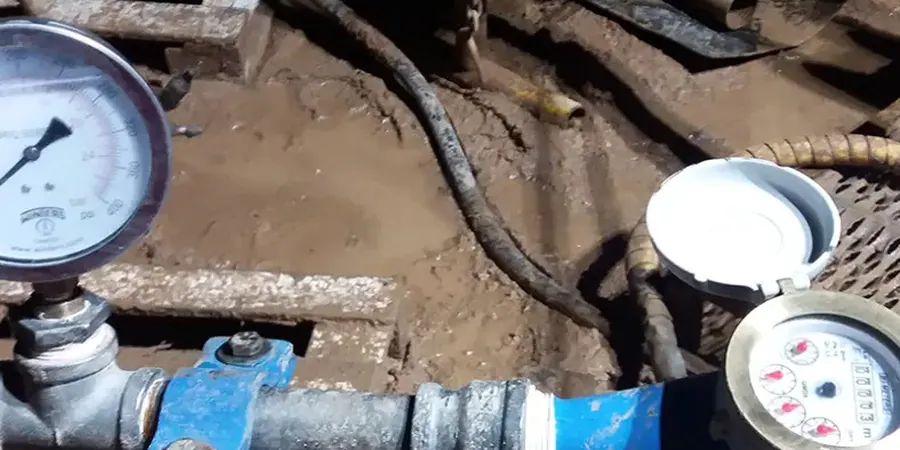
A single Lugeon stage in fractured dolerite can show permeability dropping from 10⁻⁴ to 10⁻⁷ m/s as joints close under higher pressure.
Methodology and scope
- Lefranc: constant or falling head in a borehole, suited to silts, sands, and weathered dolerite.
- Lugeon: multi-stage pressure test in a packer-isolated section, ideal for jointed bedrock.
Local considerations
A retaining wall project on the lower slopes of Mount Wellington, where dolerite boulders sit in a clay matrix, failed during excavation because no one checked the perched water table. The contractor assumed the material was free-draining, but the clay layers held water, built up pressure, and the wall face sloughed. A field permeability test would have shown the low hydraulic conductivity of the matrix and triggered a drainage design change. Missing that step cost time and material. In Hobart, where weathered dolerite can hide low-permeability zones behind a blocky surface, skipping the field test is a real risk.
Applicable standards
AS 1726:2017 Geotechnical site investigations, AS 1289.6.7.3 Standard practice for design and installation of groundwater monitoring wells, ISRM Suggested methods for field permeability testing (Lugeon test)
Associated technical services
Lefranc Permeability Test
Constant or falling head test in a single borehole, suitable for soils and weathered rock. We use a 75 mm standpipe and measure head drop over time to calculate hydraulic conductivity. Ideal for shallow excavations, drainage design, and dewatering estimates.
Lugeon Packer Test
Multi-stage pressure test in fractured rock. A pneumatic packer isolates a 1 to 3 m section of the borehole, and we apply incremental pressure stages to measure flow rate. The Lugeon value (L.u.) is used for dam foundations, tunnel lining design, and grouting programs.
Typical parameters
Frequently asked questions
What is the difference between a Lefranc and a Lugeon test?
The Lefranc test uses a constant or falling head and works in soils and weak rock where the borehole stays open without a packer. The Lugeon test is run inside a packed-off interval under controlled pressure, so it suits fractured rock masses where the permeability changes with joint opening. For Hobart's dolerite, we often start with Lugeon in the lower borehole and switch to Lefranc in the weathered upper zone.
How much does a field permeability test cost in Hobart?
A single Lefranc test in a prepared borehole runs between AU$970 and AU$1,420, including mobilization within the greater Hobart area. Lugeon tests cost more because of the packer equipment and multi-stage procedure. The price depends on site access, borehole depth, and number of test intervals, but the range above is a realistic baseline for standard conditions.
Do I need a field test if I already have lab permeability results?
Lab tests on undisturbed samples measure the permeability of the intact material, not the fractures or macropores. In Hobart's dolerite terrain, joints and weathering zones dominate groundwater flow. A field test gives a bulk permeability that represents the real ground conditions, including secondary features like fissures and root holes that lab samples miss.