Hobart sits at the base of Mount Wellington, where the Derwent River meets the Tasman Sea. With an annual rainfall of around 620 mm and a varied geology of dolerite, sandstone, and alluvial deposits, soil reinforcement demands careful engineering. We develop geogrid specification packages that define aperture size, tensile strength at 2% and 5% strain, and junction efficiency for every project layer. Before finalizing a design, we often recommend a plate load test to confirm subgrade modulus under working loads. This baseline ensures the selected geogrid matches actual site stiffness rather than assumed values from reference tables.
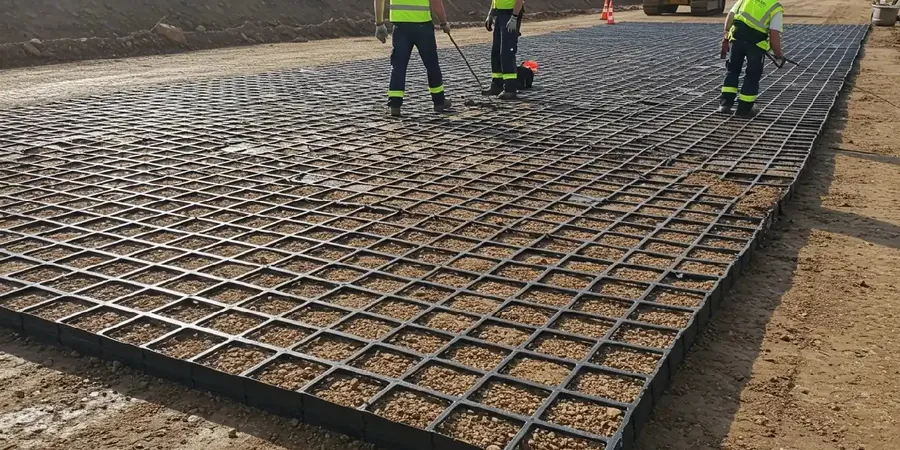
Geogrid specification in Hobart must account for dolerite rock fragments that can puncture grids during backfill compaction — we test for installation damage.
Methodology and scope
- Tensile strength per AS 4133.4.2, tested in both machine and cross-machine directions
- Aperture stability modulus determined from in-plane torsional resistance
- Long-term design strength reduced for creep, installation damage, and chemical degradation
Local considerations
On many Hobart projects, the biggest risk we catch is underspecifying the geogrid for the actual fill material. When angular dolerite is used as backfill, standard grids suffer cut filaments at junction points, reducing tensile capacity by up to 30% within the first compaction pass. Our lab runs installation damage tests using a full-scale compaction rig with the specified fill. We also check the subgrade CBR before and after placement to quantify stiffening effect. Without this verification, you can end up with a reinforced layer that acts more like unreinforced fill once the grid is damaged.
Applicable standards
AS 4678-2002 Earth-retaining structures, AS/NZS 1170.2:2011 Structural design actions – Wind actions, AS 4133.4.2 Standard test method for tensile properties of geogrids
Associated technical services
Geogrid tensile testing
Laboratory tensile tests per AS 4133.4.2 on production rolls, reporting strength at 2%, 5%, and rupture. Results used to set minimum average roll values (MARV) for project specs.
Installation damage assessment
Full-scale compaction over geogrid samples with project-specific fill material. We measure retained tensile strength after compaction to adjust long-term design strength.
Aperture stability evaluation
Torsional resistance testing to confirm grid openings stay stable under load. Critical for granular fill interlock and aggregate confinement in unpaved roads and working platforms.
Typical parameters
Frequently asked questions
What tensile strength should I specify for a geogrid under a 500 mm road base in Hobart?
For a 500 mm granular base over subgrade with CBR 2–4, we typically recommend a biaxial geogrid with minimum tensile strength of 20 kN/m at 2% strain. This matches typical deflection limits for flexible pavements under AS 3727.
How does the geogrid specification differ for a retaining wall versus a slope reinforcement project?
For retaining walls, the geogrid must resist pullout from the active zone, so junction strength and soil-geogrid interface friction are critical. We specify higher tensile strength (30–40 kN/m) and shorter embedment lengths. For slope reinforcement, longer grids with moderate strength (15–25 kN/m) and higher elongation capacity work better to accommodate rotational movement.
How much does a complete geogrid specification package cost in Hobart?
A full specification package including tensile testing, installation damage assessment, and written report typically ranges from AU$600 to AU$1,730 depending on the number of grid types tested and the complexity of site conditions.
What standard governs geogrid specification in Australia?
The primary standard is AS 4678-2002 for earth-retaining structures, which references geogrid testing per AS 4133.4.2. For reinforced soil slopes, we also follow the guidelines in AS/NZS 1170.2 for load combinations and the AASHTO LRFD method for pullout resistance.