The difference between Sandy Bay and Glenorchy tells you a lot about Hobart’s soils. Sandy Bay sits on weathered dolerite with good bearing capacity. Glenorchy has deeper alluvial deposits along the Derwent River. That contrast directly affects how we approach MSE (Mechanically Stabilized Earth) wall design in Hobart. For projects in Glenorchy, we often need to check the foundation soil first with an ensayo SPT to confirm the reinforcement zone won't settle. In Sandy Bay, the rock closer to surface allows shorter reinforcement lengths. Each site requires a tailored evaluation.
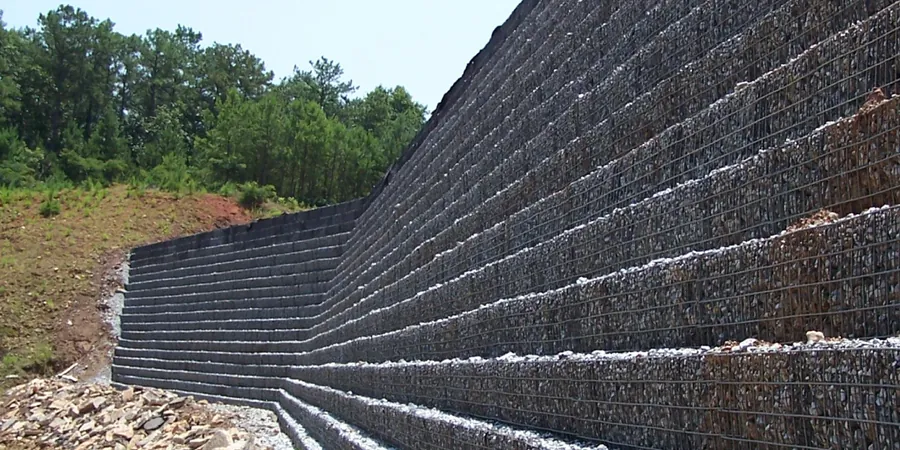
MSE walls tolerate differential settlement better than rigid concrete walls, making them ideal for Hobart’s variable fill conditions.
Methodology and scope
Local considerations
Hobart’s geology includes dolerite, alluvial silts, and colluvial clays. The dolerite itself is strong, but the residual clay above it can be problematic. In the eastern suburbs, we often find shallow groundwater within 2 m of the surface. That water reduces effective stress in the reinforced zone and increases corrosion risk for steel strips. For MSE wall design in Hobart, we always install drainage layers behind the facing panels. Without proper drainage, hydrostatic pressure builds up and can push the wall forward. We also check for dispersive soils along the Coal River Valley — those erode internally and destabilize the reinforced mass.
Applicable standards
AS 4678:2002 — Earth-retaining structures, AS/NZS 1170.4:2007 — Structural design actions (seismic), AS 1726:2017 — Geotechnical site investigations, FHWA-NHI-10-024 — MSE wall design guidelines
Associated technical services
Full MSE wall design and certification
From preliminary layout to final stamped drawings. Includes reinforcement type selection, internal stability analysis, external sliding and overturning checks, and connection detailing with the facing system.
Backfill testing and quality control
Gradation, compaction, and friction angle verification during construction. We run on-site density tests and laboratory triaxial or direct shear tests to confirm the fill meets the design assumptions.
Typical parameters
Frequently asked questions
What soil conditions in Hobart make MSE walls unsuitable?
Soft compressible clays deeper than 3 m under the wall footprint can cause excessive settlement that the reinforcement straps cannot accommodate. Peat layers in the Derwent estuary also pose a risk. In those cases, ground improvement or piled foundations are needed first.
What is the typical cost range for an MSE wall design in Hobart?
The cost for a complete MSE wall design package in Hobart ranges between AU$1.720 and AU$6.860, depending on wall height, reinforcement length, and site access. This includes geotechnical investigation, structural calculations, and sealed drawings.
How do you handle seismic loading for MSE walls in Hobart?
Hobart is in a low to moderate seismic zone per AS 1170.4. We apply a horizontal seismic coefficient of 0.08g to 0.12g depending on the site subsoil class. The internal stability check includes a pseudo-static analysis with the reinforcement layers resisting the inertial forces.