During the upgrade of the Southern Outlet approach, we faced a 9-metre fill over soft alluvial clays near the rivulet. The client needed a reliable embankment that wouldn't creep or settle unevenly under traffic. Our team started with a detailed site investigation: boreholes, test pits, and a MASW survey to map the bedrock profile. We also ran a CBR vial assessment on the subgrade to set the design modulus. That data fed into staged construction planning with horizontal drains and geotextile reinforcement. The result was a stable embankment that met AS 4678 earth-retaining structure requirements without overdesign.
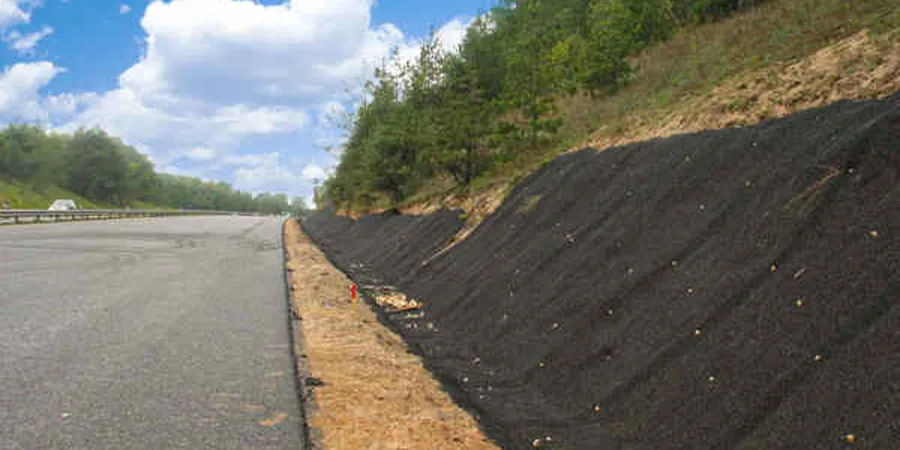
A dolerite residual profile can shift from stiff clay to fractured rock within 3 metres – embankment design must account for that variability.
Methodology and scope
Local considerations
We use a 20-tonne smooth drum roller with a vibratory function for compaction of each 300 mm lift. A nuclear density gauge provides in-situ moisture and density readings every 500 m², as per AS 1289.5.8.1. The biggest risk in Hobart's temperate climate is placing fill during wet winter months. Saturated dolerite fines become sticky and difficult to compact. We monitor weather windows closely and maintain a stockpile of dry imported granular material to cap the working platform when needed. Without that discipline, the embankment can develop soft zones that lead to long-term rutting or slope instability.
Applicable standards
AS 4678-2002 Earth-retaining structures, AS 1289.5.1.1 Compaction control (standard Proctor), AS/NZS 1170.2:2011 Structural design actions – wind, AUSTROADS Guide to Pavement Technology Part 2: Pavement Structural Design
Associated technical services
Subsurface Investigation for Fill Foundations
Boreholes, test pits, and geophysics to characterise the foundation soil profile. We target critical transitions between cut and fill zones.
Compaction Control and Quality Assurance
Field density testing (nuclear gauge and sand cone), moisture monitoring, and laboratory Proctor curves to ensure fill meets specification.
Slope Stability Analysis for Embankment Sides
Limit-equilibrium analysis using Bishop and Morgenstern-Price methods. We assess slip surfaces through foundation clay layers and dolerite interfaces.
Settlement and Consolidation Monitoring
Installation of settlement plates, piezometers, and survey markers. We track vertical movement during staged construction and surcharge periods.
Typical parameters
Frequently asked questions
What is the typical cost for a road embankment design study in Hobart?
For a standard road project with 3–5 boreholes, compaction control during construction, and slope stability analysis, the cost ranges between AU$2.050 and AU$6.440. Exact pricing depends on embankment height, site access, and the number of test locations.
How does Hobart's dolerite geology affect embankment design?
Dolerite weathers into residual clay and rock fragments with highly variable thickness. The design must consider stiff foundation layers that can change to soft clay within a few metres. We use staged investigation to map these transitions and adjust fill placement accordingly.
What compaction standard is required for road embankments in Tasmania?
Most local road authorities require 95% to 98% of standard Proctor density (AS 1289.5.1.1) for fill layers. Moisture content must be within ±2% of optimum. For high-traffic routes, modified Proctor may be specified.
How long does the geotechnical design process take for a typical Hobart project?
From initial site investigation to final design report, expect 4 to 8 weeks for a 2–6 metre high embankment. Larger structures with soft foundation layers require additional lab testing and settlement analysis, extending the timeline to 10–12 weeks.