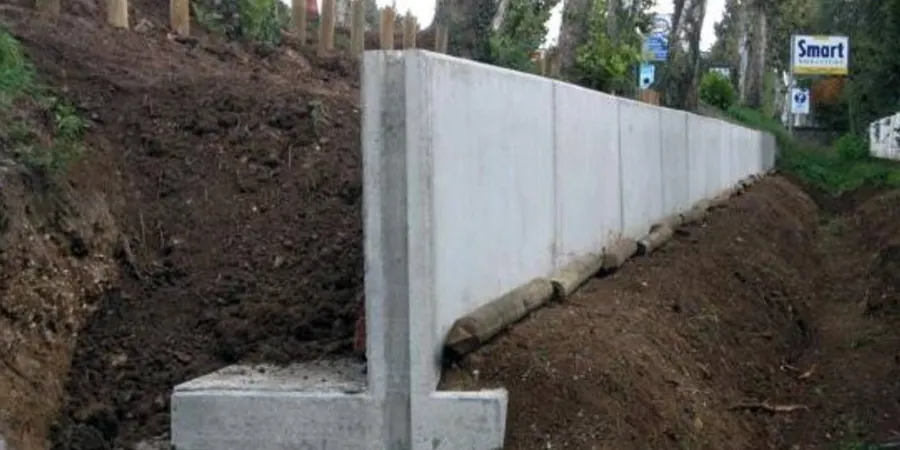
We were called to a site on the eastern shore of Hobart, near Rosny Hill. The owner planned a two-story extension cut into a sloping block. The exposed face was over four meters high. That is when retaining wall design becomes the centerpiece of the project. We excavated two test pits and found a layer of sandy clay over weathered dolerite. The water table was low, but the clay had moderate plasticity. We ran triaxial tests to get drained shear strength parameters. Without those numbers, you are guessing. We combined that data with a slope stability analysis using Bishop's method. The wall geometry had to account for the surcharge from the new structure. We recommended a reinforced concrete cantilever wall with a properly designed drainage blanket behind it. The drainage layer is critical in Hobart because of the winter rainfall. We also checked the factor of safety for sliding and overturning. That wall has been standing for three years now. No cracks, no movement. That is what happens when you do the math upfront.
In Hobart, the cost of fixing a failed retaining wall often exceeds the cost of the original design by three times.
Methodology and scope
Local considerations
Hobart has a population of just over 250,000, but the urban area extends across steep terrain. The elevation rises from sea level at the waterfront to over 300 meters at Mount Wellington. That topography creates a lot of cut-and-fill scenarios. We have seen walls fail because the designer assumed the soil was granular when it was actually cohesive. The saturated clay after three days of rain turned into a fluid mass. The wall rotated forward by 15 centimeters. The homeowner had to pay for a full replacement plus legal fees. The other risk we see is inadequate compaction of the backfill. Loose fill settles over time and creates voids behind the wall. Those voids collect water and increase hydrostatic pressure. We recommend compaction testing at every lift. The AS 4678 standard requires a minimum of 95% standard Proctor density for backfill. We enforce that on every project. Ignoring drainage or soil parameters in Hobart's wet climate is a gamble you do not want to take.
Applicable standards
AS 4678-2002 (Earth-Retaining Structures), AS 1726-2017 (Geotechnical Site Investigations), AS/NZS 1170.2:2021 (Wind Actions), AS 3600-2018 (Concrete Structures)
Associated technical services
Geotechnical Investigation for Retaining Walls
We drill boreholes or dig test pits to characterize the soil profile. We collect undisturbed samples and run lab tests for shear strength, compressibility, and permeability. The final report includes soil parameters, groundwater conditions, and recommended bearing pressures for the wall footing.
Structural-Geotechnical Design Integration
We work with structural engineers to translate soil parameters into design loads. We calculate active, passive, and seismic pressures. We provide input on wall type, reinforcement, and drainage details. We also review construction drawings for compliance with AS 4678.
Typical parameters
Frequently asked questions
What is the typical cost for a retaining wall design in Hobart?
The cost for geotechnical investigation and design input for a retaining wall in Hobart usually falls between AU$1.440 and AU$5.610. This range depends on the wall height, soil conditions, and the number of boreholes required.
How deep should the footing be for a retaining wall in Hobart?
The footing depth depends on the soil type and frost penetration. In Hobart, we typically recommend a minimum depth of 600 mm for cohesive soils and 450 mm for granular soils. Deeper footings are needed on sloping sites or where expansive clays are present.
What is the difference between a gravity wall and a cantilever wall?
A gravity wall relies on its own weight to resist overturning. It is wider at the base and works well for walls under 3 meters. A cantilever wall uses a reinforced concrete stem and base slab. It is thinner and more efficient for walls between 3 and 6 meters. The choice depends on soil bearing capacity and available space.
Do I need a drainage system behind every retaining wall?
Yes, in almost all cases. Hobart receives significant winter rainfall. Without drainage, water builds up behind the wall and increases lateral pressure by up to 100 percent. We always specify a granular drainage layer and weep holes or a perforated pipe system.