Hobart grew along the Derwent estuary, and much of the inner suburbs sit on soft alluvial clays and estuarine silts laid down over thousands of years. As redevelopment pushed toward the waterfront and the lower slopes of Mount Wellington, engineers found themselves dealing with ground that couldn't support conventional shallow footings without excessive settlement. That's where deep soil mixing design became a practical alternative. Instead of excavating and replacing poor material, we treat it in situ by injecting a cementitious binder and blending it with the native soil to form stiff columns or panels. The technique works particularly well in the saturated silty clays found around the CBD and the eastern shore, where water tables sit within a metre of the surface. Before we finalise a deep soil mixing design, we always run a laboratory permeability test on the untreated soil to assess binder migration, and we cross-check the estimated column strength with triaxial compression results from treated samples.
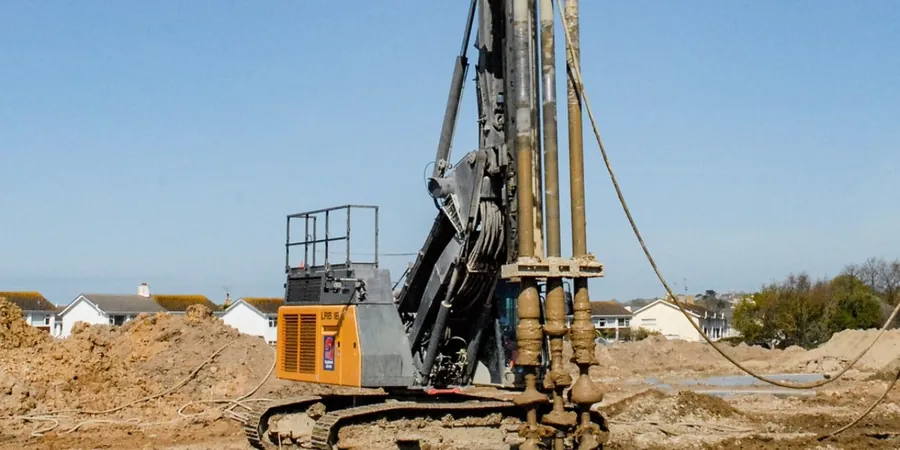
A well-designed deep soil mixing column in Hobart's estuarine clay can achieve a target UCS of 1.5 to 3 MPa within 28 days.
Methodology and scope
Local considerations
One mistake we see from contractors new to Hobart's soft ground is assuming that a standard cement dosage from mainland projects will work here. The local estuarine clays contain varying amounts of organic matter and soluble sulphates, so a generic 250 kg/m³ mix may set slowly or never reach the design strength. That leads to columns that are too weak to transfer load to the underlying dense layer, causing differential settlement between treated and untreated zones. Another common error is neglecting the effect of tidal groundwater movement on binder washout before the mix sets; if the binder isn't stabilised fast enough, the column perimeter erodes and the effective diameter shrinks. We address both risks by running site-specific trial mixes and by adjusting the binder set time with controlled accelerators.
Applicable standards
AS 1726 – Geotechnical site investigations, AS 4678 – Earth retaining structures (DSM walls), AS 1289 – Compressive strength of soil-cement
Associated technical services
Laboratory mix design and optimisation
We prepare and test trial mixes using soil samples from the site, varying binder type and dosage to find the most economical combination that meets the target strength.
Column layout and structural design
Using finite-element analysis and load-transfer models, we determine column spacing, diameter, and depth to limit total and differential settlement to acceptable values.
Construction-phase quality control
Our technicians monitor binder flow rate, penetration speed, and mixing energy during installation, and we collect wet-grab samples for UCS testing at 7 and 28 days.
Post-treatment verification testing
We extract continuous core samples from completed columns to check uniformity, measure in-situ strength, and compare results against the design assumptions.
Typical parameters
Frequently asked questions
What is the typical cost of deep soil mixing design in Hobart?
For a full design package including lab mix design, structural analysis, and QC documentation, the cost typically ranges from AU$2,430 to AU$9,320, depending on the number of trial mixes and the complexity of the load configuration.
How long does the laboratory mix design phase take?
A standard mix design programme with three binder dosages and two curing ages requires about 4 to 5 weeks from sample receipt to final report. If accelerated curing at 50°C is used, preliminary results can be available in 10 days.
Can deep soil mixing treat peat layers common in Hobart's northern suburbs?
Yes, but peat requires higher binder dosages, often with a slag-cement blend, and the design must account for long-term creep. We have successfully treated peat up to 6 m thick using dry-mix methods with binder dosages above 350 kg/m³.